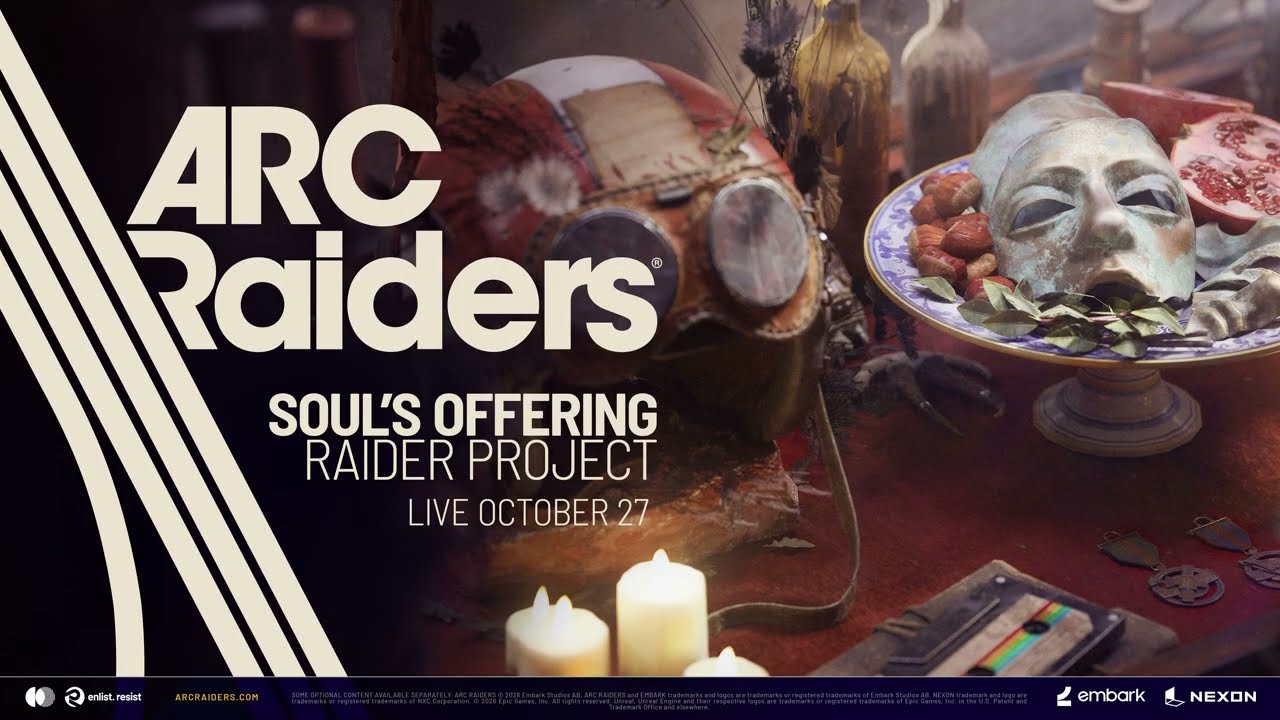
First Look: Thermaltake's A1500 Dual and its whole dual-system AI lineup /// GetRekt Special: the AI takeover of gaming, from engines and Epic to Steam slop and scared indies /// Crossout Remastered: free graphics overhaul out now on PC and consoles /// Sparking! Zero's NEO DLC trailer shows off the roguelike Limit Breaker Journey mode /// ARC Raiders' Soul's Offering Raider Project goes live 27 October /// New: the release schedule. Every big game, month by month, at getrekt.com/release-schedule /// Cyberpunk: Edgerunners 2 hits Netflix 20 Oct /// Call of Duty: Modern Warfare 4 lands 23 Oct
First Look: Thermaltake's A1500 Dual and its whole dual-system AI lineup /// GetRekt Special: the AI takeover of gaming, from engines and Epic to Steam slop and scared indies /// Crossout Remastered: free graphics overhaul out now on PC and consoles /// Sparking! Zero's NEO DLC trailer shows off the roguelike Limit Breaker Journey mode /// ARC Raiders' Soul's Offering Raider Project goes live 27 October /// New: the release schedule. Every big game, month by month, at getrekt.com/release-schedule /// Cyberpunk: Edgerunners 2 hits Netflix 20 Oct /// Call of Duty: Modern Warfare 4 lands 23 Oct
GetRekt Special: The AI Takeover of Gaming Is Here. What It Means for the Games, the Engines and the People Who Make Them
Epic wants "no more hand-written code", the engines now let AI agents drive the editor, a third of new Steam games are AI-flagged, and indie devs are hiding their work from clones. We dug into what the AI takeover actually means for games, and for us.
By infused
24 October 2026
TL;DR
>>
Epic has gone all in: a reportedly "AI first" Disney game, a vibe-coded launcher, and an AI MegaJam with US$65k in cash and up to US$50k in grants. It also walked back a rule that made AI mandatory.
>>
The engines are going AI-native. Unreal 5.8, Unity AI and Roblox Studio all ship official MCP servers so AI agents can drive the editor, and UE6 puts LLMs at the centre. Godot banned AI code contributions.
>>
AI-flagged games went from 10.9% of new Steam releases in 2024 to 30.8% in 2026, but they're under-selling, and Next Fest drowned in more than 8,000 demos.
>>
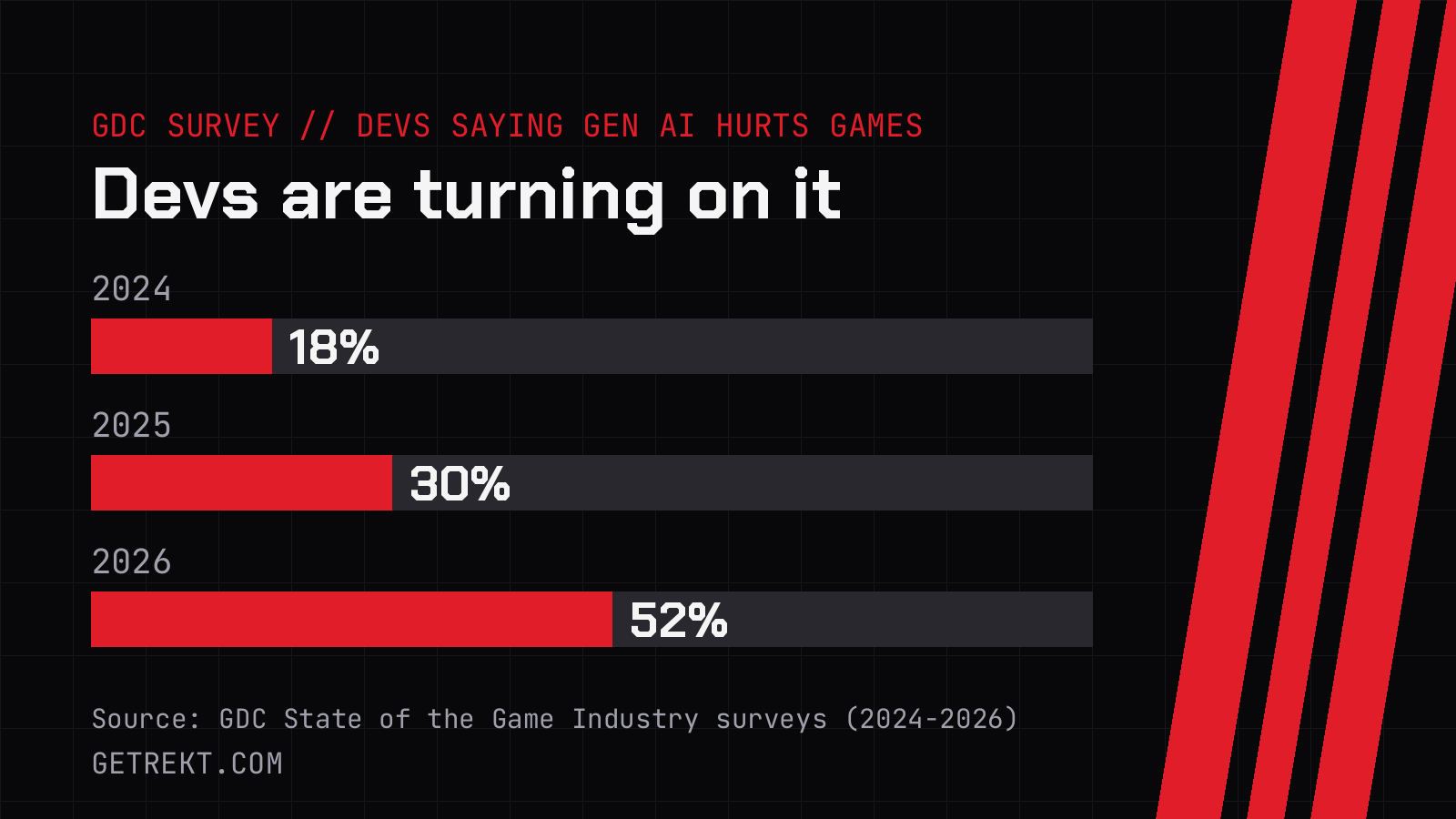
AI clones are scaring indies off showing their work, and 52% of devs now say gen AI is hurting the industry, up from 18% two years ago.
>>
In NZ, 55% of devs are uncomfortable with AI tools, and NZGDA is pushing for consent-based training and copyright reform.
If you’ve felt like every second gaming headline this month has had “AI” in it, you’re not imagining things. In the space of a few weeks:
Epic reportedly told developers on a flagship Disney game there’d be “no more hand-written code”.
Epic launched a game jam where AI agents are effectively team members, and dangled cash and grants for it.
Steam Next Fest drowned in more than 8,000 demos, a big chunk of them flagged as AI-made.
Indie devs started hiding their games because AI clones turn up before the real thing does.
So we did the reading. This is the GetRekt Special on AI in games: what’s actually happening, whether the engines themselves are being rebuilt around it, and what it means for the people who make and play games, including here in Aotearoa and across the ditch.
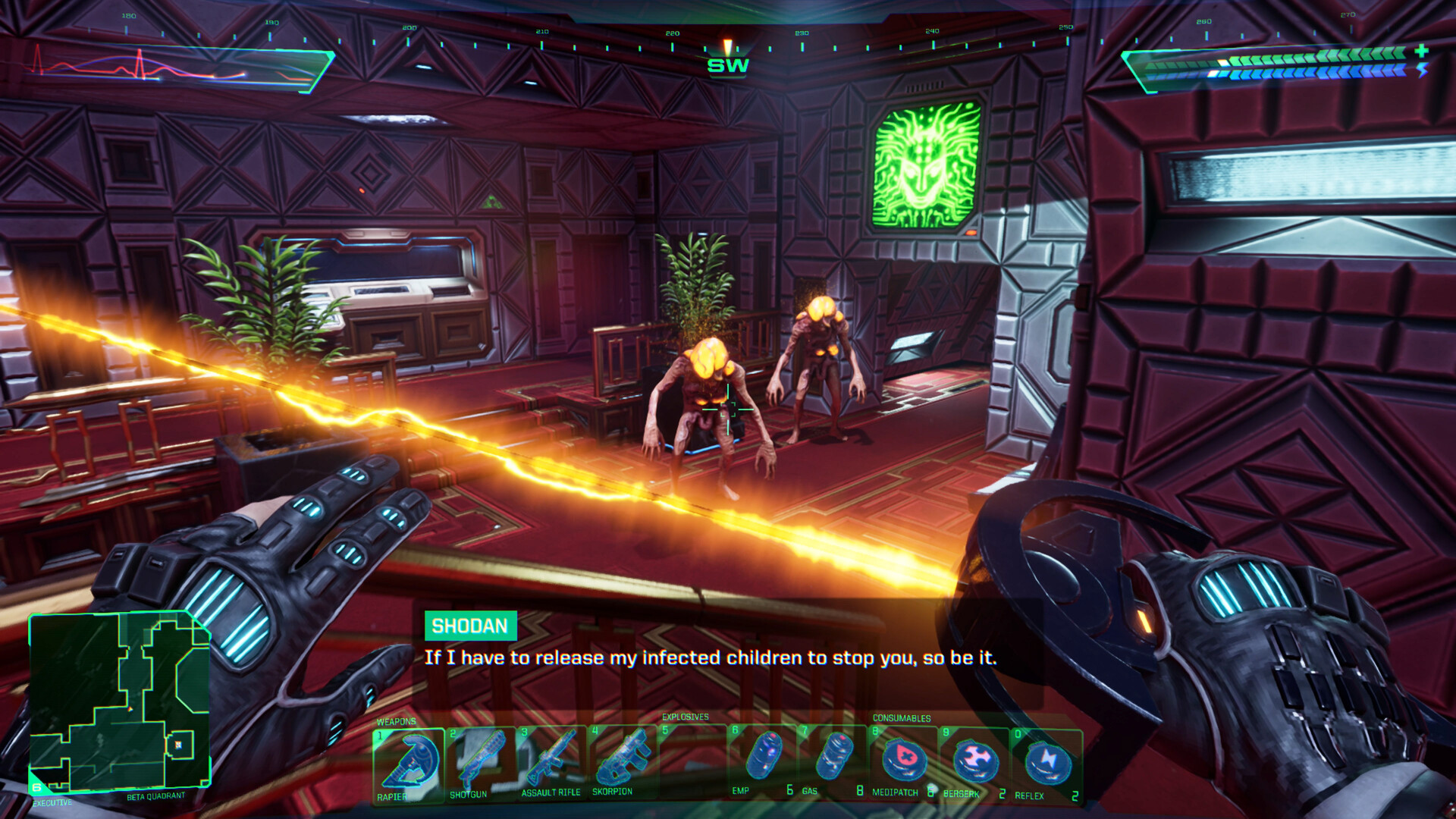
Gaming's original AI takeover: SHODAN making threats in the System Shock remake. Image: Nightdive Studios
The week Epic went all in
Epic is the loudest player in this, so it’s the natural place to start.
The Disney project: earlier this month Bloomberg reported that Epic had delayed its unannounced Marvel and Star Wars shooter with Disney, originally slated for March 2027, and moved it to an “AI first” production model. Per Bloomberg’s anonymous sources, an internal message from one of the game’s directors said “no more hand-written code”, and art would be “generated with full AI workflows”. Epic’s statement says the project is “embracing AI-accelerated development, led by Epic developers who are the visionaries and creative drivers”.
Tim Sweeney’s line: Sweeney says Epic is moving developers around “to retool for maximum AI acceleration”, insists “the aim isn’t to do the same stuff with fewer people”, and promises “a new golden age of gaming”. That’s from the same company that laid off more than 1,000 people, about 20% of staff, in March. Sweeney said at the time that those cuts were down to weak Fortnite engagement and “not related to AI”.
The launcher: Epic proudly announced it had “vibe coded” a new Epic Games Launcher preview. To its credit, the preview supports Linux. To its discredit, GamingOnLinux says it was very broken at first.
The labels fight: Sweeney has spent the past year attacking Steam’s AI disclosure labels.
Last November he said they make “no sense” because AI will be in “nearly all future production”.
In June he called them a “Scarlet Letter”.
This week, according to GamesRadar, he called Valve’s policy “abhorrent”, saying it forces devs to write “a political statement to be used against them by the hate mob”.
The Epic Games Store has no AI disclosure requirement at all.
The AI MegaJam
Then came the jam. On 22 October the Unreal Engine account posted “Vibe your way to 50K”, with a Matrix red-pill image featuring a hand with too many fingers. You can’t make it up. The details, from the official jam page:
Format: build a playable game in Unreal Engine or UEFN in four days, from 12 to 15 November. You can go solo or in a team of up to five humans, plus “unlimited AI agents”.
Where: online, or in person at Digital Jungle in San Francisco, where Epic says teams from Anthropic, Google, OpenAI and Meshy will be on hand.
Prizes: US$65,000 in cash across categories, plus separate development continuation grants of up to US$50,000 per engine. The categories include “Walkie-Talkie”, for a narrative game with LLM-powered NPCs.
Setup: entrants are encouraged to set up their AI tools, coding agents and MCP connections ahead of time.
The walk-back: the original FAQ said you had to use AI. After the backlash, Epic called that a mistake, and the FAQ now answers “Do I have to use AI?” with “No.”
The reaction was savage. ResetEra’s thread ran for pages of “AI slop” and “clownshow”. One X reply pointed out that Ludum Dare was running 24-hour jams back in 2002, without anyone needing a chatbot. TechRadar summed it up by saying “Epic seems to be almost trolling gamers”. Reports also say Poncle, the studio behind Vampire Survivors, is “reviewing” a planned Fortnite collab over Epic’s gen AI use. Treat that one as reported but not confirmed.
Are the engines being rebuilt for AI? Yes, and fast
This is the big question, and the honest answer is yes, at the tooling level, and it’s already happened. The shift isn’t “press a button, get a game”. It’s quieter and more important than that: the engines are being opened up so that outside AI agents, like Claude, Codex and Gemini, can drive the editor directly. The plumbing for that is something called MCP (Model Context Protocol), and within a few months every major commercial engine shipped it.
Unreal Engine 5.8 (17 June) shipped an experimental official MCP plugin that, in Epic’s words, “enables agentic AI systems to connect to the Unreal Editor”. Forum users say the documentation is still patchy.
Unreal Engine 6 was unveiled at Unreal Fest in June, with early access aimed at the end of 2027. It merges UE5 and UEFN, and Epic’s own blog says it sees “LLMs, generative AI models, and tools like Claude and Codex playing a central role” in building content. Gameplay code is shifting towards Verse, which has the side effect of being a much easier language for an AI to write than Blueprint spaghetti.
Unity AI went into open beta on 4 May. It’s an in-editor agent with Ask, Plan and Agent modes, an AI Gateway so you can bring your own model, and an official MCP server. It’s free on Pro and Enterprise, and US$10 a month on Personal after a trial.
In February, CEO Matt Bromberg promised it would let devs “prompt full casual games into existence with natural language only”.
By August’s earnings call, it was “still very early, just still in beta”. Funny how that goes.
Roblox is arguably furthest along.
Its Cube model generates 3D objects, and in February its “4D” generation, which makes working, interactive objects like drivable cars, went into open beta.
Roblox Studio has its own MCP server with full agent loops and a playtest agent, plus an official plugin for Claude and Codex.
Godot is the exception. In June the Godot Foundation banned AI-authored code, PRs submitted by AI agents and vibe-coded contributions to the engine itself. Its reasoning: “AI cannot take responsibility, and we can’t trust heavy users of AI to understand their code enough to fix it.” Plenty of Godot users still hook up community MCP servers to their own projects, but the engine won’t take AI code into its own source.
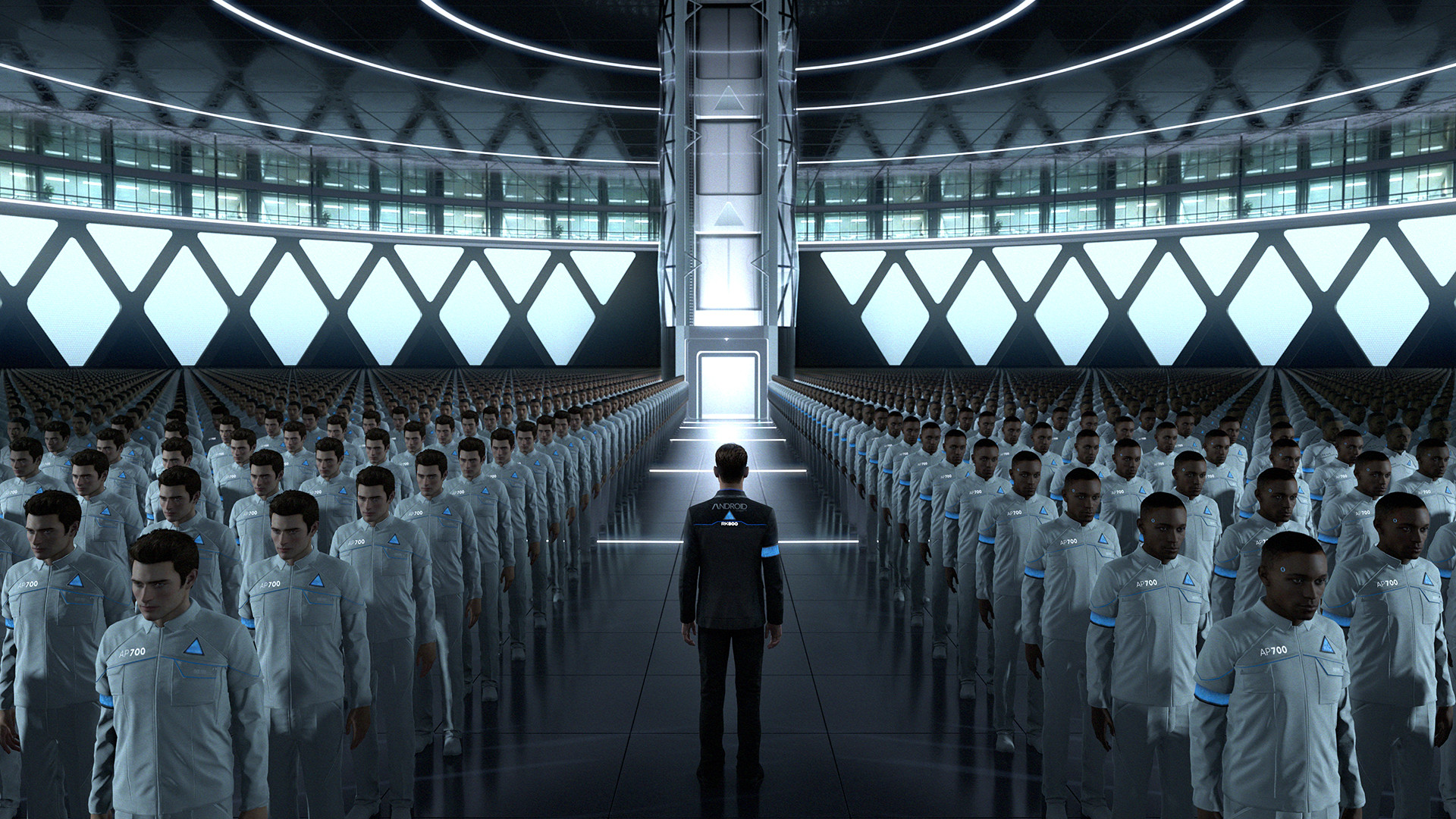
An android glitching through in Detroit: Become Human. Image: Quantic Dream
Then there’s the stuff that wants to skip engines entirely.
Google’s Project Genie generates playable worlds from a prompt. When it launched in January, Unity’s share price fell by roughly 18% to 24% in a day, depending on who you ask, and Roblox and Take-Two dropped as well.
The reality check: Genie makes 60-second worlds at 720p, and Microsoft’s AI-generated Quake II demo ran at about 10fps. World models are a party trick for now, not a threat to Unreal.
So, are engines becoming more AI-friendly? Unreal, Unity and Roblox have all made it a core strategy, and with UE6 Epic is designing the next engine around it. The bit nobody has proven yet is whether the games that come out the other end are any good.
The flood is real
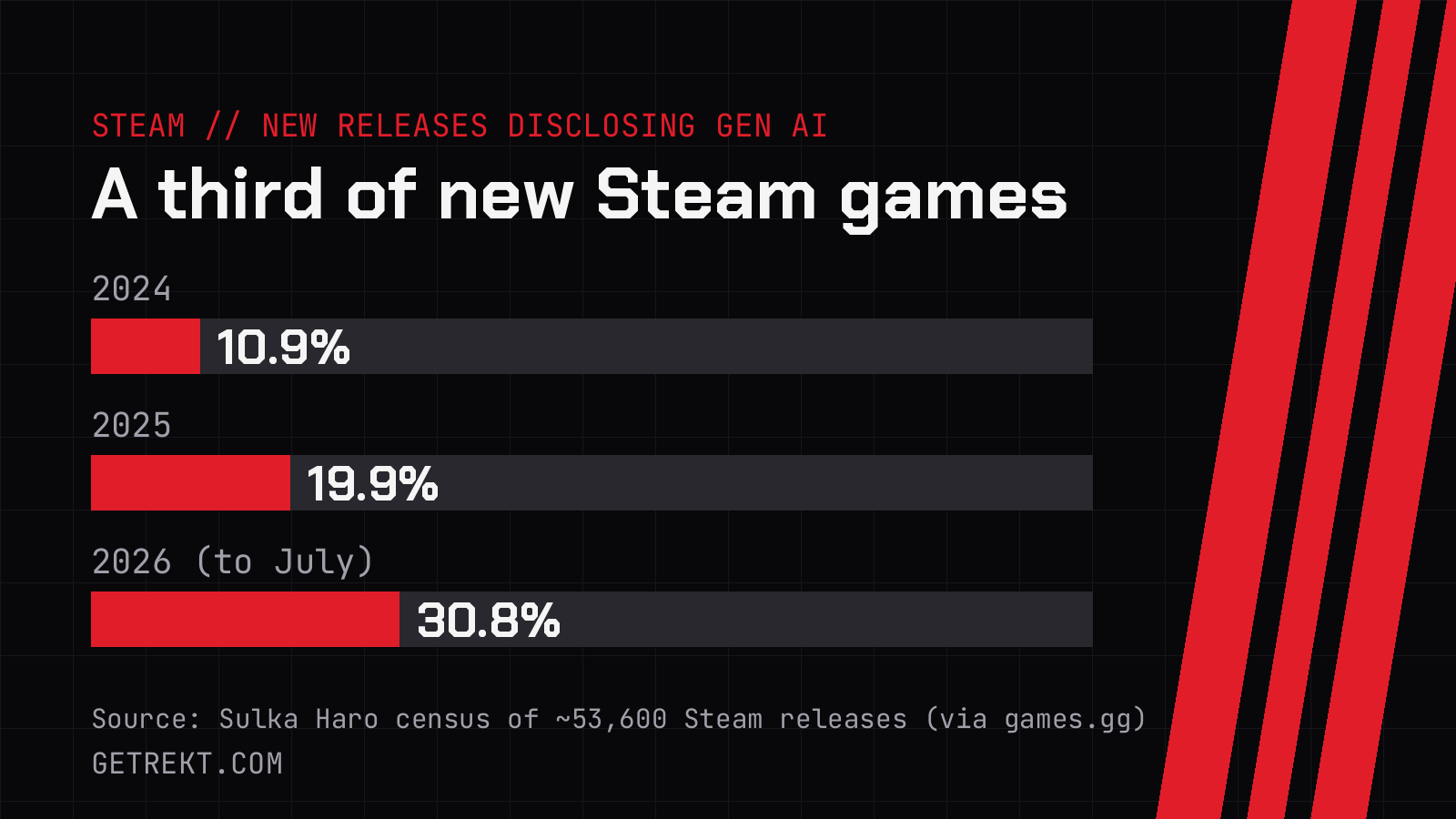
Share of new Steam releases disclosing generative AI. Data: Sulka Haro (via games.gg). Image: GetRekt
Since January 2024, Valve has made developers disclose AI-generated content that players actually see. It tweaked the rules this January so that behind-the-scenes coding tools don’t count. The numbers since are wild.
The growth: Pax Dei co-founder Sulka Haro looked at about 53,600 Steam releases. In 2024, 10.9% of new releases carried an AI disclosure. In 2025 it was 19.9%, and in 2026 so far it’s 30.8%. AI-flagged releases went from about 13 a month to about 530 a month. His projection is that most new Steam games will carry the flag by 2027 or 2028.
The money doesn’t follow: in the first quarter of this year, AI-flagged games were about 28% of new releases but only around 17% of estimated sales. GamesRadar’s take on Haro’s data was that 60% to 90% of the growth in monthly releases comes from AI games, and “almost none of them make money”.
Next Fest: October’s Next Fest had more than 8,000 demos, roughly double June’s. Players are now begging Valve for an AI filter. One third-party tally put about 36% of the demos as AI-disclosed. That figure isn’t from Valve, but it lines up with everything else.
The big games aren’t immune: Totally Human’s count last November found 10,258 AI-disclosed games that had made about US$660 million between them. Most made less than US$10,000, but the list also included Stellaris, The Outlast Trials and Black Ops 6.
One Reddit comment TechRadar quoted sums up the mood: “We’re being bombarded with thousands of AI slop games.” It’s not just Steam either. The Switch eShop’s shovelware problem got bad enough that Nintendo changed how its charts work, and itch.io now tags games as “AI Generated” or “No AI”.
Indies are now scared to show their work
This is the bit that genuinely worries us. As Ars Technica laid out, AI coding tools have made cloning so fast that indie devs are pulling back on the one marketing tool they can afford: showing their game early.
Alliance Arts pulled the Next Fest demo of its demon-themed drinking game, Drunken Goddess Reflux, at the last minute. It said it feared the demo “could be used to quickly imitate or replicate the game’s presentation and gameplay with AI”, possibly “before our launch”. The demo now only runs in closed sessions.
Freya Holmér posted a prototype of her Tetris-style game built around a rotating pivot. Within days, vibe-coded copies made the concept playable before she’d released her own. Her verdict: “it kinda disincentivizes me from sharing progress when there are slop ghouls around every corner”.
Lucas Pope, who made Papers, Please, says you don’t talk about work in progress now because “it’s going to get slurped up by AI or people are going to copy it”.
Sos Sosowski, who made McPixel, put the bind most bluntly: “Don’t share your game—no sales. Share your game—gets stolen.”
Not everyone agrees. Ivan Lago of Howltide Games argued that “if AI can copy your game overnight, it wasn’t a real game”. But for a solo dev whose whole hook is one clever mechanic, that’s cold comfort.
The genuinely fun bit: AI mod mashups
To be fair, it’s not all doom. XDA’s Samarveer Singh has been playing with AI-assisted mod mashups that transplant entire gameplay systems between games, which goes way beyond texture swaps.
The highlights: Spider-Man’s web-swinging in Arkham Knight, Skate 3’s tricks and scoring in Modern Warfare 2, Thomas the Tank Engine in Skyrim, and a “GTA Skate 3 Trilogy” project that runs Skate 3’s systems inside the classic GTAs.
Singh’s own test: he got Skate 3 running in Vice City in about 15 minutes, though the cars on Ocean Drive lost their collision and Tommy kept falling through the world.
His verdict: these are fragile prototypes, and “the modder still has to figure out what needs to communicate with what”.
That’s the version of AI most gamers could actually get behind: a power tool in the hands of people who love games, making daft things that were never going to be commercial products anyway.
The backlash ledger
Clair Obscur: Expedition 33 lost its Indie Game Awards over AI placeholder textures that shipped at launch. Image: Sandfall Interactive / Kepler Interactive
Players have shown again and again that they’ll punish AI they didn’t sign up for:
Clair Obscur: Expedition 33 was stripped of its Indie Game Awards Game of the Year and Debut Game wins last December. Sandfall had said it used no gen AI, but AI placeholder textures shipped at launch before being patched out.
Larian got hammered after Swen Vincke said the studio used gen AI for concept art and placeholder text on Divinity. By January it had dropped gen AI from concept art, and its writing director said no AI text touches the game.
ARC Raiders launched with text-to-speech voices built from licensed actor recordings, and Eurogamer called it the game’s “one inexcusable decision”. It still sold 12.4 million copies. In March, Embark said it had re-recorded lines with real actors because “a real professional actor is better than AI”.
Black Ops 7’s calling cards were flagged as AI. Activision admitted to using “AI tools” without denying the specifics.
Anno 117 had an AI image that Ubisoft said was a placeholder that “slipped through”.
Crimson Desert’s developer Pearl Abyss apologised for shipping AI props and admitted it “should have clearly disclosed” them.
Total War: Shogun 2 Complete Edition: as of this week, it’s under fire over suspected AI assets from an outside developer. Creative Assembly says it doesn’t use gen AI for assets and is investigating.
ARC Raiders sold 12.4 million copies despite the backlash over its AI voices. Image: Embark Studios
Devs vs the bosses
Developers who say gen AI is hurting the industry. Data: GDC State of the Game Industry. Image: GetRekt
Here’s the real fault line. The people making games are turning against AI, while the people running the companies are going harder.
GDC’s 2026 survey of about 2,300 developers found 52% say gen AI is hurting the industry, up from 30% a year earlier and 18% the year before that. Only 7% think it’s positive. Executives were the most keen.
Usage is levelling off: the Game Developer Collective found personal use of gen AI dropped from 36% to 29% this year, and 47% think it’ll make games worse.
The bosses:
Krafton declared itself “AI First”, put about US$69 million into GPUs, then offered every employee voluntary redundancy right after a record profit.
Square Enix wants AI doing 70% of its QA and debugging by the end of 2027, announced alongside layoffs.
Reports from anonymous sources said King staff cut in Microsoft’s 2025 layoffs were replaced by AI tools they’d helped build.
Sony calls AI “an important foundational technology” and expects a “meaningful increase in the volume” of games.
Voice actors fought back. SAG-AFTRA’s year-long video game strike ended in 2025 with consent and disclosure rules for AI digital replicas. The union also took Epic to the US labour board over Fortnite’s AI Darth Vader.
What do players actually think?
Quantic Foundry: its survey of nearly 1,800 gamers found 85% sit below neutral on gen AI in games, and AI-written quests and dialogue were especially hated.
GameDiscoverCo: its data tells a slightly different story. Only about 31% are negative about an AI disclosure, and just 8% say they’d outright refuse to buy a game that has one.
Read together, those say most players hate the idea of AI in games but will still buy a good game that used it quietly. That’s exactly why Sweeney wants the labels gone.
The view from here: NZ and Australia
NZGDA’s AI statement: in July the NZ Game Developers Association released its first AI statement. It calls for AI trained only on data from developers who have given “explicit consent”, for copyright reform built on consent and compensation, and for AI that empowers local studios rather than replacing people. It has also been running an AI hui at NZGDC to thrash out industry guidelines. In its own words, the hui is “designed to surface real disagreement, not paper over it”.
The workforce report: NZ’s first game development workforce report, released on 1 October, found 55% of local devs are uncomfortable using AI tools at work, even though 60% see practical value in them.
Revenue up, jobs down: the NZ industry passed NZ$1 billion in revenue this year, up 32%, while headcount fell 11.1% to 1,261 full-time-equivalent staff. NZGDA doesn’t blame AI for that, and neither do we, but it’s exactly the sort of gap AI-first bosses will point to.
Kiwi studios: Dean Hall of RocketWerkz, who made DayZ and Icarus, compared AI fears to people once worrying about Google and Wikipedia. His studio hand-builds its maps but uses AI for internal jobs like answering questions about the codebase.
Australia: IGEA wants “proportionate and risk-based” AI regulation for games. The federal government ruled out a text-and-data-mining copyright exception for AI training. And the ANZ indie showcase Frosty Games Fest “stands firmly against NFTs and Generative AI in games”. Fun fact: Leonardo.ai, one of the bigger AI image tools, started in Sydney as a game asset generator before Canva bought it.
So what does it all mean?
The engines have already changed. UE 5.8, Unity AI and Roblox Studio all let AI agents drive the editor, and UE6 is being built with AI at its centre. Whatever you think of it, the tools devs use every day are now AI-first by design, and that won’t be rolled back.
The volume problem is the real crisis. If a third of Steam releases are already AI-flagged and that’s heading past half, discovery gets even harder for everyone. Good human-made indies get buried, and good AI-assisted ones get tarred with the same brush. Steam desperately needs better filters, and Epic wants fewer labels, not more. Those two positions are on a collision course.
Indies get squeezed from both sides. They can’t afford to market without showing their work, and showing their work now means getting cloned. Expect more closed playtests, more surprise launches and more people holding mechanics back until day one.
The money hasn’t shown up yet. AI games are flooding storefronts but under-selling. Unity’s “prompt a full game” became “still very early” within six months, and Epic’s flagship AI-first project has been delayed, not accelerated. The productivity miracle is still a pitch deck.
The line players will accept is becoming clear. AI as a back-end power tool for code assistance, QA, upscaling, mod tools and dynamic difficulty is largely tolerated. AI replacing the art, writing and voices people pay for is not. Every studio that tested that line in the past year got burned.
Our take
We’re not anti-tech. GetRekt literally runs on automation, and AI coding tools are useful in the right hands. Nobody’s mourning the end of boilerplate code. But there’s a big difference between AI helping a developer and AI replacing one, and right now too many bosses are deliberately blurring that line because it looks great to shareholders.
Epic is the case study. Sweeney swears it’s not about doing the same with fewer people, a few months after cutting 1,000 jobs. He calls disclosure labels “abhorrent” when they’re simply telling customers what they’re buying. And his company promotes an AI game jam with a six-fingered hand. If you’re that confident AI makes better games, you shouldn’t be scared of a label. Let the games speak for themselves.
Meanwhile the people who actually make games, from GDC’s 52% to the 55% of Kiwi devs who are uncomfortable with it, are telling anyone who’ll listen that this is going badly. Indies are hiding their work. Next Fest has become a landfill. A tiny group of executives are deciding the future of an art form that millions of people love, mainly based on what it does to headcount.
Here’s where we land. The engines are going AI-native whether we like it or not, so the fight now is over honesty and craft. Label it. Pay the artists and actors whose work trained it. Give us filters so we can find the good stuff. And make games people actually want to play, because no amount of “vibing” has fixed that part yet.
Where’s your line on AI in games? Fine for code but not for art? Would you buy a game with an AI disclosure? Or is it all slop? Have it out in the comments, or come argue about it in the GetRekt Discord.


Comments 0
Quick check before we post that