>>
Gamers Nexus has called Tim Sweeney a "lunatic" over his year-long war on Steam's AI disclosure label.
Epic's boss calls Steam's AI label a political hate tool while his studio bins hand-written code and rebuilds Unreal around AI agents. We went through the receipts.

Gamers Nexus has called Tim Sweeney a "lunatic" over his year-long war on Steam's AI disclosure label.
Sweeney has called the label a "Scarlet Letter", "abhorrent" and a "forced political disclosure", yet Epic's own Fab store requires the same thing.
Epic says AI models will play "a central role" in Unreal Engine 6, and its UE 5.9 preview was built mostly by AI agents.
Bloomberg reports Epic's Marvel and Star Wars shooter went "AI-first", with "no more hand-written code".
GDC's 2026 survey found 52% of developers think generative AI is hurting games. Only 7% think it helps.
Tim Sweeney has spent a year telling anyone who will listen that Steam’s AI label is a hate crime against developers. He’s called it a “Scarlet Letter”, “abhorrent” and a “forced political disclosure”. This weekend Gamers Nexus put out a 39-minute video titled “Tim Sweeney is a Lunatic”, and after going through the receipts, we struggle to argue with the headline.
Because the Steam label isn’t really the story. The story is a billionaire who built his reputation fighting Apple and Google for the little guy, now ordering his own studio to stop writing code by hand, turning the next Unreal Engine into an AI pipeline, and getting furious that players might be told about it.
Gamers Nexus says it offered Sweeney the chance to go on camera and talk through his AI views. Instead, according to the channel, he unfollowed and blocked it on X after it mocked his line that the world should “avoid moral, regulatory, and geopolitical panics over AI”, pointing out that Epic paid US$520 million in FTC penalties in 2022 over Fortnite’s dark patterns and children’s privacy.
The video then walks through a year of Sweeney posts and Epic decisions. We’ve checked the main claims against the original reporting, and they mostly hold up. Here’s the lot.
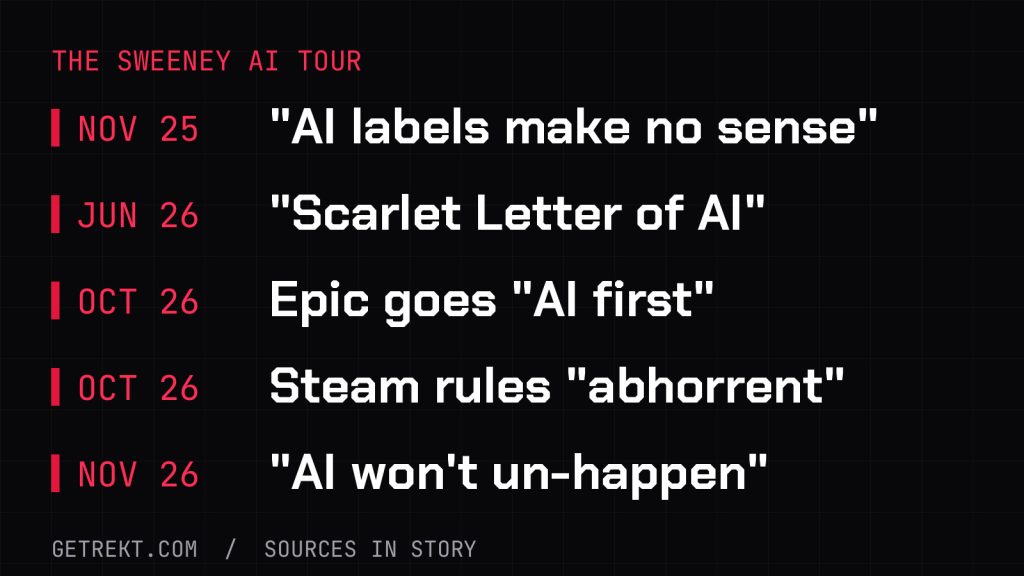
Valve introduced its AI disclosure in January 2024 and rewrote it in January 2026. It’s narrower than Sweeney makes it sound.
Here’s how Sweeney has described that box over the past year:
The problem is that Epic’s own asset store, Fab, also makes sellers disclose AI. When people pointed that out, Sweeney said Fab is “a business to business marketplace” whose customers need to know where content came from. So businesses deserve to know what they’re buying, but the people paying US$70 for a game don’t. Sure, Tim.
Valve hasn’t officially responded to any of it. Counter-Strike 2 artist Ayi Sánchez did: “This is like saying food products shouldn’t have their ingredients list.” Former Valve writer Chet Faliszek told Sweeney he was “just treating players like they’re stupid”.
No one at Epic has used the phrase “AI-centric” for Unreal Engine 6. They don’t need to. At Unreal Fest in June, Epic’s development boss Marcus Wassmer said LLMs and tools like Claude and Codex will play “a central role” in UE6, with engine features exposed to AI agents through the MCP protocol.
It has only gone further since.
Early access for UE6 is still pencilled in for the end of 2027. To be fair, the AI is bring-your-own-model and optional, and Verse and the Fortnite merger are bigger architecture changes. But when the engine running a huge chunk of the industry is built around generating content, a lot more Unreal games will be ticking Steam’s box. Gamers Nexus makes that point, and it’s the most convincing explanation for why Sweeney takes the label so personally. It isn’t a mystery. It’s his business model.
On 12 October Bloomberg reported that Epic’s delayed Marvel and Star Wars shooter, once due in March 2027, had been switched to an “AI-first” production model using Anthropic’s Claude. Per Bloomberg, one of the game’s directors told staff “No more hand-written code”, with art to be “generated with full AI workflows”. Epic said it is “embracing AI-accelerated development” led by its developers.
Sweeney confirmed it the same day: “We have a huge pivot underway here at Epic, moving developers around to retool for maximum AI acceleration.” He insisted the aim isn’t doing “the same stuff with fewer people”.
The rest of Epic’s year:
So the man saying a disclosure label will kill games is running a company that has lost more than a thousand staff in a year and is now betting its biggest new game on Claude. It’s a lot easier to shoot the messenger than explain that to players.
The AI stuff is part of a bigger pattern of Sweeney picking fights on X.
The guy who calls a disclosure label “political” has opinions on senators, governors, Nvidia’s board and the White House’s friends. Labels are political. Everything else is just Tim being Tim.
He isn’t completely making it up. A Game Oracle study reported by PC Gamer found Steam games with an AI disclosure got about 53% fewer reviews than similar games without one, and the reviews they did get were more negative. A GameDiscoverCo survey of about 3,800 Steam players found most weren’t fussed, with only about 8% refusing outright.
So the label does cost some games attention. But that’s players using information to make a choice, which is the whole point of a label. If people don’t want AI-made art, hiding that from them isn’t protecting developers. It’s protecting sales from customers.
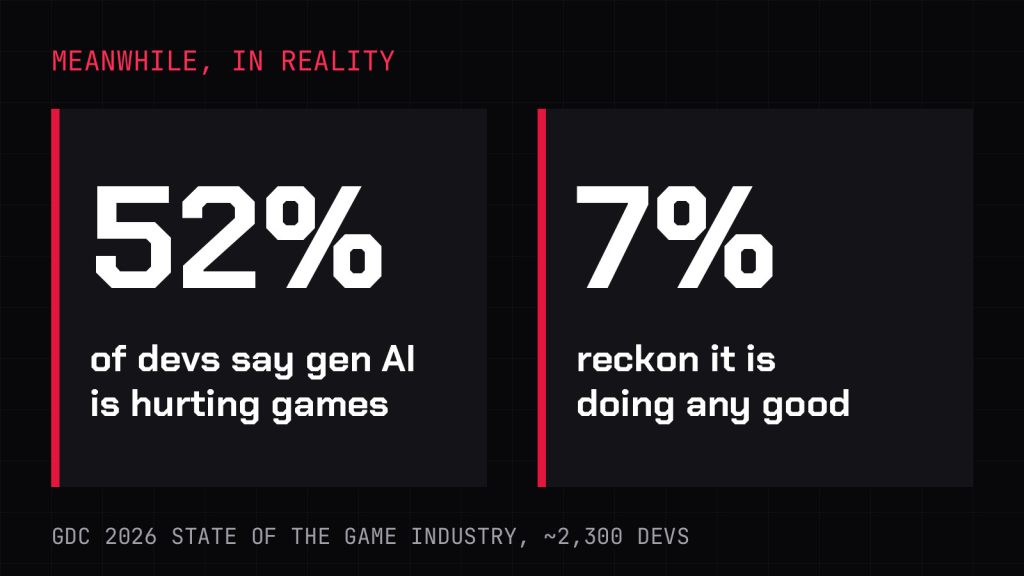
Developers aren’t on Sweeney’s side either. GDC’s 2026 survey of about 2,300 industry workers found 52% think generative AI is hurting the games industry, up from 30% the year before. Only 7% think it’s doing any good.
Telling players a game uses AI-generated art isn’t a political statement. It’s a fact, like listing the engine, the platforms or the age rating. Sweeney knows this, because his own marketplace demands exactly the same disclosure from the people selling to him.
What’s changed is that Epic has gone all in. Its biggest new game is being built “AI-first”, its engine is being rebuilt around agents, and its CEO needs the rest of the industry to come along. A little box on Steam saying “this was made with AI” is a problem for that plan, so the box has to be cancel culture, a hate mob, a scarlet letter. Anything except what it is.
This is the same bloke who took Apple and Google to court in the name of consumers. Now consumers are the hate mob, Steam’s 20 billion US dollar year is “holding gaming back”, and the bloke whose company paid half a billion in FTC penalties wants us to skip the moral panic. The only scarlet letter here is the one Tim keeps pinning on himself, one post at a time. Sweeney is rekt, and he did it to himself.
Reckon Sweeney has a point, or has he lost the plot completely? Come argue about it in the GetRekt Discord.
More on this: Sweeney calls Steam’s AI label a scarlet letter, Sweeney says Valve “held gaming back”, Epic goes “AI first” and our AI takeover special.
Team Meat is revisiting its 2010 platformer with new art, music, levels and secrets. Danny B returns, the Steam page promises 300-plus levels, and a r...

Riot's next big League update brings a modernised client, a fresh look for Summoner's Rift and gameplay changes in 2027. The proper reveal lands in Ja...
GGG's latest Covens of Umbra hotfix tackles broken life recovery and Imbued Gems. The preceding patch also bins a shrine damage penalty and makes Gwen...
Comments 0
Quick check before we post that