>>
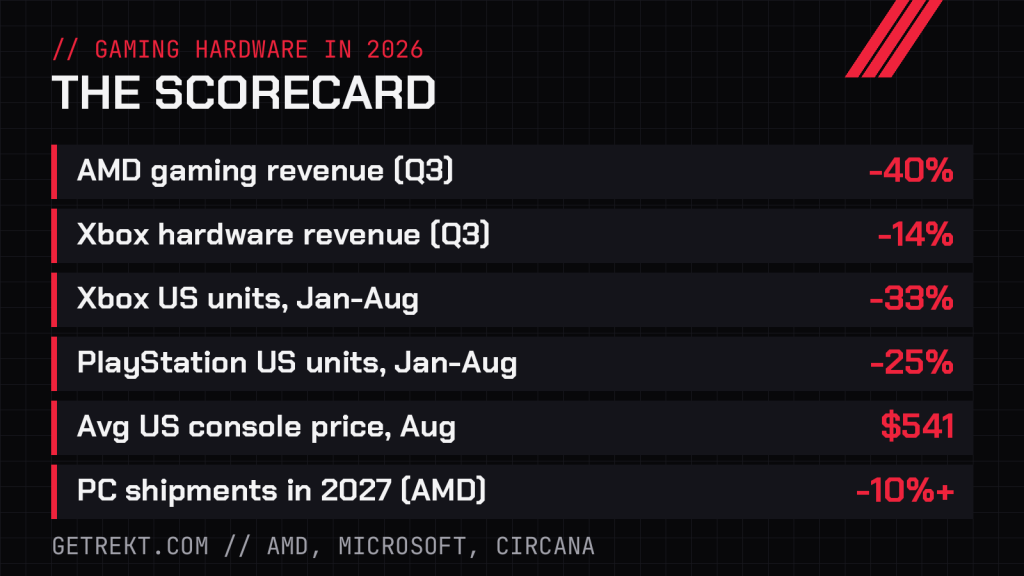
AMD gaming revenue fell 40% to US$773 million in Q3 2026 while the company hit a record US$13.4 billion.
AMD just had its best quarter ever. Its gaming business fell 40%. With consoles at decade lows, Nvidia going quiet on GeForce and AI eating all the RAM, we dig into the fall of gaming hardware.

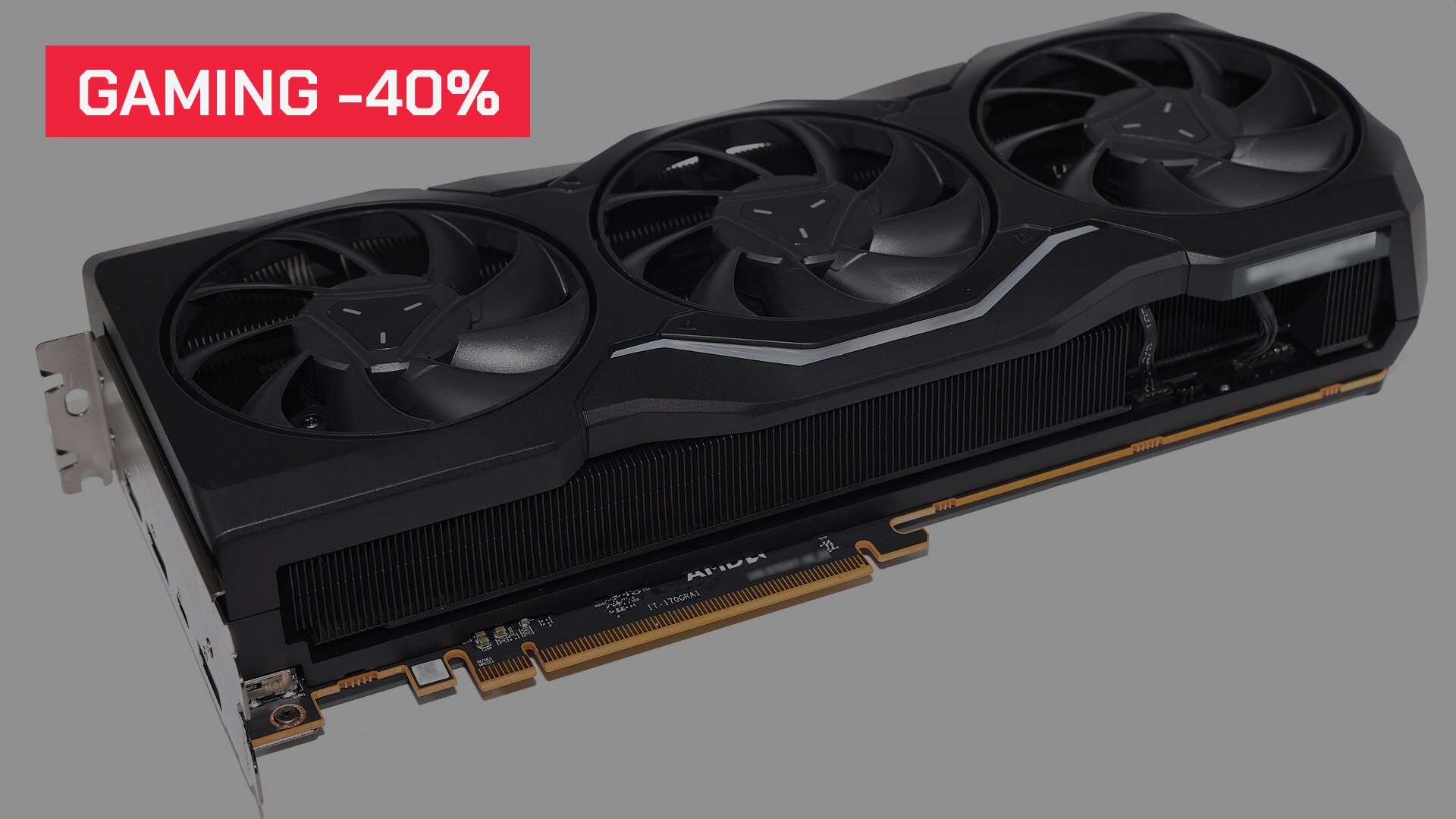
AMD gaming revenue fell 40% to US$773 million in Q3 2026 while the company hit a record US$13.4 billion.
Gaming is now under 6% of AMD. Data centre made US$8.5 billion, up 97%.
AMD blames the late console cycle and weaker Radeon sales, and expects client and gaming to fall 20%+ next quarter.
US Xbox unit sales are at an all-time low and PlayStation is at its lowest since 2013, as AI-driven RAM prices push console prices up.
AMD is planning for PC shipments to fall by double digits in 2027. Gaming isn't dead, but cheap hardware is.
AMD just had the best quarter in its history. Record revenue, US$13.4 billion, up 45% on last year. Champagne all round. Unless you are the part of AMD that makes stuff for gamers, in which case your quarter looked like a GTA character who forgot to save.
AMD’s gaming business made US$773 million between July and September, down 40% from US$1.3 billion a year earlier. Gaming is now under 6% of the company. Data centre, meaning AI chips and servers, made more than ten times that.
And it is not just AMD. Console sales in the US are at their lowest in more than a decade, Xbox hardware keeps shrinking, Nvidia doesn’t even report gaming as its own line any more, and the RAM in your next PC costs a bomb because AI data centres bought it all first. So, is this the end of gaming? Let’s go through it.
AMD posted its Q3 2026 results on 3 November (US time). The headline numbers:
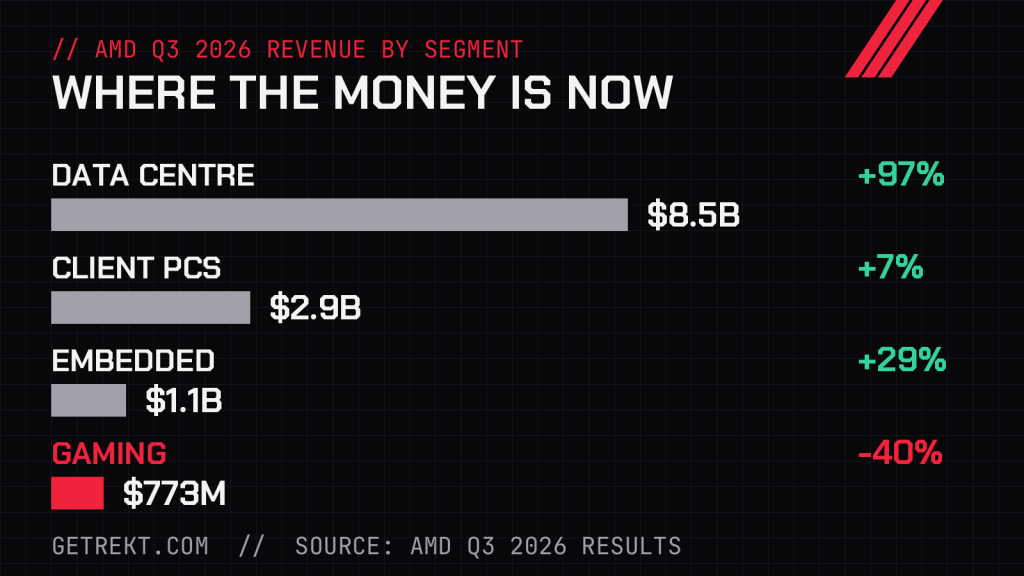
AMD’s gaming segment is two things: the custom “semi-custom” chips inside PlayStation 5 and Xbox Series X|S, and Radeon graphics cards. Both went backwards. AMD’s own release blames “lower semi-custom and graphics revenue”.
On the earnings call, CEO Lisa Su put most of it on consoles, saying revenue fell “primarily due to lower semi-custom sales as expected at this stage of the console cycle.” She said gaming graphics revenue also fell year on year, though Radeon sell-through in shops picked up a bit on the previous quarter.
The bit that should worry PC gamers more is the outlook. CFO Jean Hu said AMD expects its combined client and gaming business to drop more than 20% next quarter, over Christmas, while data centre grows about 50%. And Su said AMD is planning for the whole PC market to shrink in 2027: “we are planning for PC market unit shipments to decline by a double-digit percentage.”
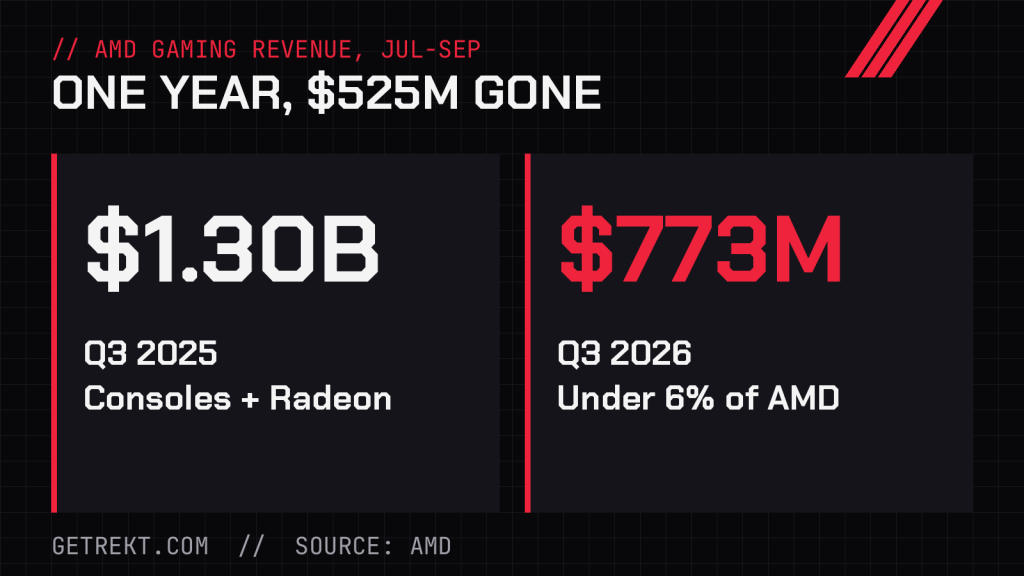
Here’s why this one stings. For years AMD was the good guy of gaming hardware. It was the reason Intel had to try again. It’s the chip in your PS5, your Xbox and your Steam Deck. And when Nvidia started charging mortgage money for GeForce cards, Radeon was the “just buy AMD” answer every forum gave.
So watching AMD ride the same AI wave as everyone else, with gaming shrinking to a rounding error in its results, is pure Obi-Wan on the lava bank energy.
To be fair to AMD, nobody on the call said it was quitting gaming. Radeon drivers are still shipping, and Su specifically called out premium consumer and desktop PCs as places AMD wants to win. But money talks, and right now it’s talking data centre. AMD told investors it expects total revenue to grow more than 80% next year, with data centre making up more than 80% of the business.
Nvidia went the same way, only faster. In its August results, Nvidia reported US$96.2 billion in revenue for the quarter, US$89 billion of it from data centre. The rest went in a new “Edge Computing” bucket of US$7.2 billion that lumps PCs in with robots and self-driving car tech. GeForce and gaming did not get their own line at all. Earlier this year Nvidia warned that supply constraints would be “a headwind to gaming” this year and beyond.
We’ve been watching this happen in real time. Nvidia pulled the RTX 5080 and 5090 from its own store, Chinese AI factories are stripping new RTX 5090s for parts, and modders found a hidden AI throttle in GeForce cards.
Consoles are copping it too. Circana’s US data for January to August showed Xbox hardware unit sales down 33% on last year, an all-time low, and PlayStation down 25%, its lowest since 2013. August alone was the weakest August for hardware sales since 2013. Circana’s Mat Piscatella summed it up: “The US hardware market has not been in a more precarious position since the early 80s.”
Microsoft’s numbers say the same. Xbox hardware revenue fell 14% in July to September, on top of a 29% drop in the same quarter last year, and Microsoft expects hardware to keep falling. That’s the quarter Xbox was teasing GTA 6 on a Series X.
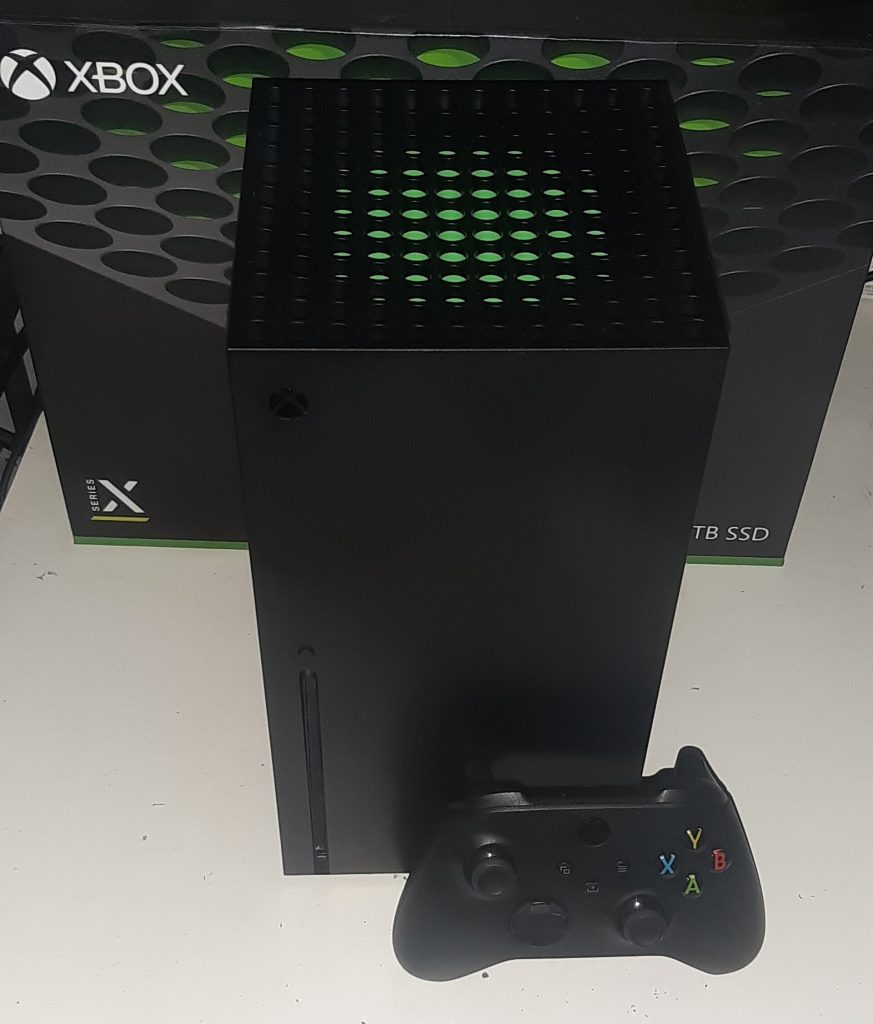
There was one bright spot. In September, US PS5 unit sales jumped 22% on Marvel’s Wolverine and GTA 6 pre-launch buying. Xbox still fell 27% and Switch 2 fell 14%. So people will buy a console when there’s a massive game to play on it. They just aren’t buying them for fun at these prices.
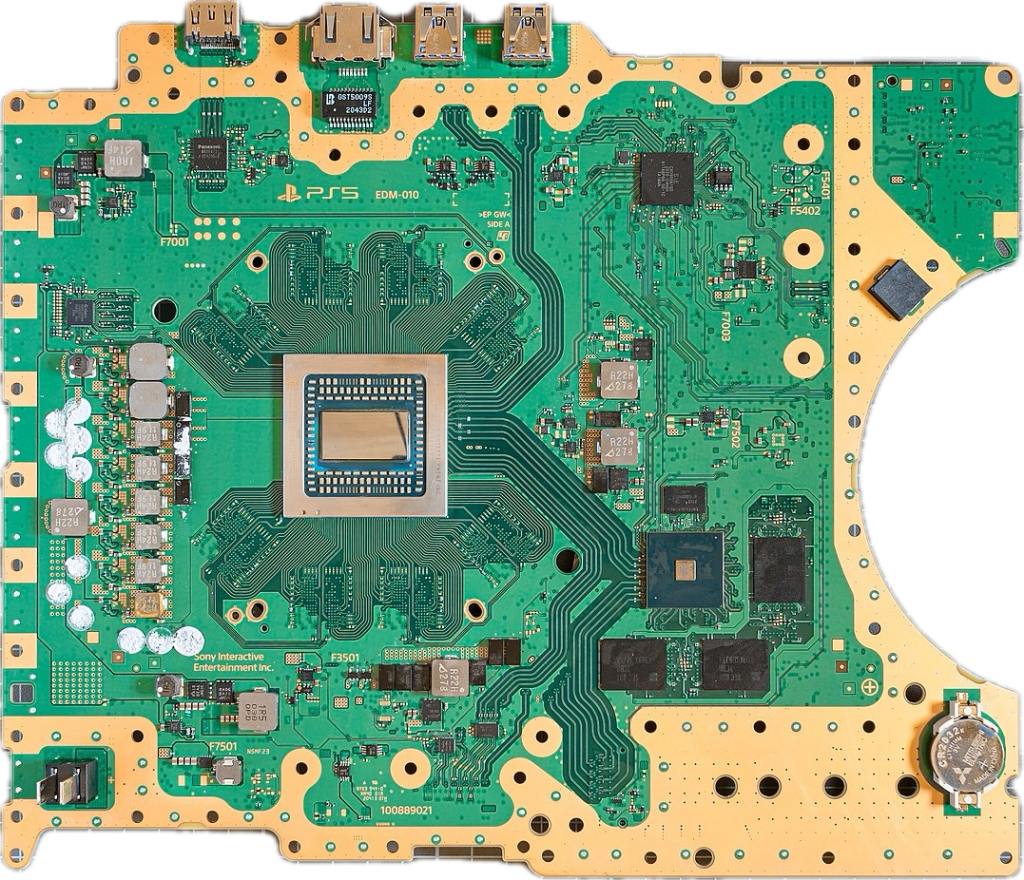
If you want one reason all of this is happening at once, it’s memory. AI data centres need ridiculous amounts of DRAM and storage, and memory makers sell to whoever pays most. That isn’t you.
Market tracker TrendForce said in February that contract DRAM prices would jump 90 to 95% in the first three months of 2026, with PC DRAM at least doubling, after big rises in late 2025. It then forecast another rise of around 60% for April to June. Every console, graphics card and gaming PC needs that memory.
That flows straight through to what you pay. Circana says the average price Americans paid for a new console hit a record US$541 in August. So far this year the average Xbox has cost US$529, up 26%, and the average PlayStation US$597, up 20%. Those are US prices. Here they get the exchange rate and GST on top.
Lisa Su said it plainly on the call: PC sales “slowed late in the quarter as higher memory and component costs weighed on demand.” Meanwhile OpenAI’s Sam Altman, whose company is one of the biggest RAM buyers on the planet, reckons the RAM in your PC is “quite terrible”. Cheers, Sam.
No. But it might be the end of cheap gaming hardware for a while.
People haven’t stopped spending on games. Circana’s September numbers had total US games spending down just 1% on last year, at about US$4.8 billion. GTA 6 lands on 19 November and it’ll move a lot of PS5s. What’s collapsing is the hardware side: fewer people buying new boxes and cards, because the boxes and cards cost more than ever.
Part of AMD’s drop is also just timing. The PS5 and Xbox Series X|S are six years old, and console chip sales always fade late in a generation. The next wave of consoles is still expected to run on AMD silicon. Microsoft has said its next Xbox hardware is being built with AMD, and Sony has been co-developing graphics tech with AMD.
The scary part isn’t one bad quarter. It’s that gaming no longer matters much to the companies that make gaming hardware. When gaming was more than a quarter of AMD’s business a few years back, it got first dibs on wafers and memory. At under 6%, it gets what’s left after the AI customers are done.
AMD didn’t betray anyone. It’s a listed company and AI is paying better than gamers ever did. But let’s not pretend this is fine either. The two companies that make basically every gaming GPU and console chip now earn the vast majority of their money elsewhere, and they’re telling us straight that consumer hardware sales will keep shrinking into 2027.
For Kiwis and Aussies, who already pay more for everything, that means hanging on to your current rig longer, getting used to console prices that only go one way, and maybe skipping the RAM upgrade until the AI bubble does whatever bubbles do. Gaming is not dead. Affordable gaming hardware is on life support, and the doctors are busy building data centres.
What do you reckon? Still riding with Team Red, or has the chosen one turned to the dark side? Come argue about it in the GetRekt Discord.
GGG's ExileCon keynote in Auckland revealed the full 1.0: two final acts in Oriath, the stealthy Shadow class, and Conquerors of Wraeclast, a league w...
A new urban map called Sabatulo, three-month seasons, multi-track unlocks, limited-gear servers and a 185,000-account ban wave. Bulkhead also owns up ...

Silver Lake and Saudi Arabia's PIF, the pair who bought EA, have reportedly held talks to buy Unity at around US$25 billion. Nothing's signed, but if ...
Comments 0
Quick check before we post that